Our Instruments
Colloidal analytics puts highest demands to the experimental equipment. For this reason, we use only high-end
instruments from leading manufacturers. The highest performance, representing the state of the art and beyond, is guaranteed.
Analytical Ultracentrifugation

Figure 1: Optima XL-A/XL-I
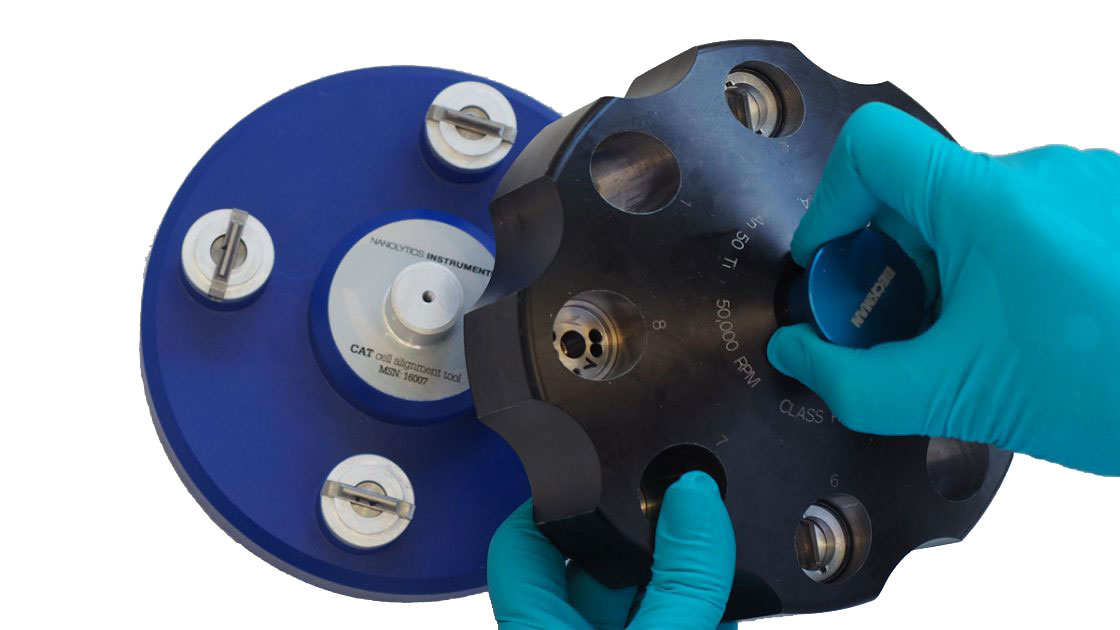
Beckman Coulter's Optima XL-A/XL-I Analytical Ultracentrifuge represents the highest performance available to
date. At an angular velocity of 60,000 rpm, a centrifugal field equivalent to 260,000 fold of the Earth's gravity arises. The instrument is equipped with two
independent optical systems, Rayleigh interference optics and Absorbance optics covering a range from 190 to 800 nm. Radial resolution is 0.01 mm, wavelength
resolution is 1 nm.
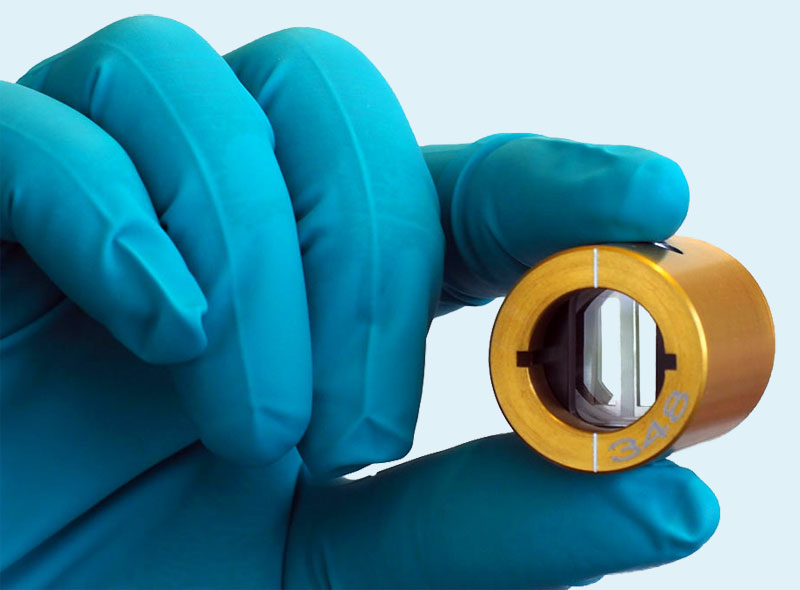
The sample cells are applicable to any solvents, including acids, bases and organic solvents. This is due to the fact that we have built our own titanium centerpieces; these parts are not supplied by the manufacturer. The cell windows are made of sapphire.
Static and Dynamic Light Scattering

Figure 2: Goniometer BI-200SM
The Brookhaven BI-200SM is a multiangle goniometer for making static and dynamic light
scattering measurements. The useful angular range is 10° to 155°, depending on the quality of the sample. Motor driven,
steps as small as 0.01° allow for extremely precise determination of structure functions. The sample cell chamber can be
temperature controlled (+5 to +80°C).
For detection, we use a high-quality photon multiplier tube with low dark counts and low afterpulsing. Detector optics include selectable pinholes. Furthermore, an Avalanche Photodiode Array BI-APD by Brookhaven Instruments is available; this detection system is optimized for the detection of red photons.
A high performance filtration system guarantees for an absolutely clean index-matching liquid.
For dynamic measurements, we use the Brookhaven BI-9000AT digital photon correlator. The maximum count rate is 40 Mcps. With up to 522 user-selectable channels, 16-bit multiplications, a delay time range from 100 ns to 1 310 s, with linear and nonlinear channel spacing, the BI-9000AT is the most flexible correlator available.
The Light Scattering setup is equipped with two light sources by Toptica Photonics; 70 mW are emitted at wavelengths of 406 and 641 nm, respectively.
Field-flow fractionation

Figure 3: Postnova HRFFF 10.000
Our Flow-Field-flow fractionation is an instrument by postnova analytics, series HRFFF 10.000.
The modular construction, especially the novel, patented separation channel, permits easy handling, especially the changing of membranes
and spacers, following the requirements of the system in question, within several minutes. Samples are injected onto the channel in dilute
solution; concentration occurs on-channel (focussing). The separation range is given to reach from 1 nm to 100 µm, or 103 to
1012, respectively.
Size exclusion chromatography - SEC-MALLS
Our SEC is equipped with degaser and analytical pumps by Postnova. Columns are selected according to the individuals
demands of the system in question. Two detectors - refractive index and light scattering - are used for characterization
of the eluted fractions.

Figure 4: Postnova RI-Detector
Postnova's refractive index detector combines high sensitivity with excellent baseline stability.
Refractive numbers from 1,00 to 1,75 are accessible, baseline noise is on a level of 2.5 * 10-9 refractive index numbers. This
outstanding performance is mainly dedicated to the sophisticated temperature control, allowing measurements between 30 and 50°C. The volume
of the cuvette is 9 µl.

Figure 5: Postnova-BIC MALLS-Detector
The multi-angle laser light scattering device PN 3070 by Postnova is actually Brookhaven Instruments'
product BI-MwA. Light scattering is measured at seven angles in high precision in a wide dynamic range. The internal PEEK cell is 100 µl
large, the scattering volume is 20 nl. Scattering is induced with a 635 nm, 35 mW laser. Providing careful calibration, molecular masses
in a range von 1000 to 109 g/mole are accessible with an error as small as 1%.
Electron microscopy

Figure 6: Electron microscope
Electron microscopy is provided by our cooperation partner, who not only contributes first class equipment, but is also a
recognized expert in TEM preparation and examination techniques. Thus, you are supplied with exceptional instrumental and human resources.
The Philips CM 300 UT (Ultra Twin) is a 300 kV device, corresponding to a wavelength of 1.96 pm. The electron source is a LaB6 cathode. The resolution is 1.3Å (line) and 1.7Å (dot), respectively. The instrument is equipped with a five-axis-goniometer and two axis tilting (alpha ± 30°, beta ± 20°). Imaging is done with a CCD camera covering 2.54 cm x 2.54 cm with 1000 x 1000 pixels. Image processing is carried out digitally.
As auxiliary equipment, the EDX detector should be highlighted. The active surface is 30 mm2, S-UTW windows allow for detection of all elements starting at boron. The resolution is 150 eV, the energy scope reaches 40 keV.
Refractometry

Figure 7: Refractometer by SLS Systemtechnik
Our refractometer is a unique, custom designed product of SLS Systemtechnik. The device features two light sources (405 and 635 nm),
beam displacement is measured in a range from -0.2° to 2.2° at a maximum dn of 0.038°. The precision is 10-4°, yielding refractive
numbers in six digit precision. The refractometer can be operated at up to 80°C. This is a absolute measurement - beam displacement is
amplified optically by means of a prism cascade and projected onto a CCD chip, yielding intensity spectra for analysis on the internal
computer. This principle of measurement distinguishes this device from typical differential refractometers currently available.
Piano
\n');
}
if ( plugin ) {
document.write('');
} else if (!(navigator.appName && navigator.appName.indexOf("Netscape")>=0 && navigator.appVersion.indexOf("2.")>=0)){
document.write('
');
}
//-->
Figure 8: Bechstein-Piano
');
}
//-->
Figure 8: Bechstein-Piano
Our Bechstein piano, built 1881, is no longer in our lab since we moved from our first
location to the Science Park Potsdam-Golm in 2006. However, we have been pursuaded to leave this instrument on our website
nevertheless. So, if you want to hear Nanolytics' manager play Alexander Skjrabin's prelude in e flat minor, feel free to
click onto the image.